
4 of the Most Common Composition Mistakes In Photography

The post 4 of the Most Common Composition Mistakes In Photography appeared first on Digital Photography School. It was authored by Andrew S. Gibson.

Common composition mistakes in photography

I’ve seen photographers make lots of mistakes when it comes to composition. That’s not a criticism – we all get things wrong from time to time. But recognizing mistakes and putting them right is a key part of improving your composition skills. In that spirit then, here are the most common composition mistakes and errors that I’ve seen photographers make.

Mistake #1: Learning the rule of thirds – and nothing else

The rule of thirds is basic composition theory and it’s important to understand it. But the mistake some photographers make is never trying to learn anything else about composition.

For example, take a look at the photo below. The tree is located on an intersection created by dividing the frame into three, according to the rule of thirds.

Common composition mistakes in photography

But is the rule of thirds the only principle of composition used in this photo? No, it isn’t. Let’s look at the other factors.

  • There is negative space around the tree. It gives the subject room to breathe and creates a sense of space.
  • The tree is the main focal point and there is nothing to compete with it.
  • The hills in the background are faded due to the weather conditions (it was raining when I made the photo), adding a sense of depth.
  • I used a long exposure (125 seconds) to blur the water and the leaves of the tree, adding a sense of motion or time passing to the photo.
  • I converted the photo to black and white to create drama.

As you can see there’s much more happening in this photo, from the point of view of composition, than simply placing the tree on a third. Once you understand how these ideas work you can use them in other photos and improve your composition skills at the same time.

Mistake #2: Not including foreground interest

This is a common mistake in landscape photography and some documentary photography. That’s because photographers in these genres often use wide-angle lenses, which usually include lots of foreground detail in the composition.

The idea of foreground interest can be a hard concept to grasp at first but it makes sense when you start to think about it.

For example, I made the following photo with a 14mm lens (a wide-angle on my APS-C camera). I wanted to tell a story about the couple in the market. Using a wide-angle lens helped me include context – the piles of vegetables in the foreground that the couple was selling. The vegetables provide foreground interest and support the story.

Common composition mistakes in photography

The same idea also applies to landscapes made with wide-angle lenses. In the photo below the ruins is the main subject. The flowers in the foreground add interest in the bottom half of the frame.

Common composition mistakes in photography

Mistake #3: Not paying enough attention to the background

Sharp backgrounds are common in documentary styles of photography and can help tell a story about the main subject. For example, in the photo below the main subject is the three men in the photo – the barber, his customer, and the man looking directly at the camera.

Common composition mistakes in photography

The detail in the background supports the main subject and helps tell its story. We can see every detail, from the wall behind the men to the barber’s tools and products. These details are an interesting and important part of the photo.

Sometimes the opposite approach is required and you need to blur the background out to remove distractions. Part of the skill of being a photographer is knowing when to blur the background and when to keep it sharp. In some portraits (like the one below, made with an aperture of f/1.8) you can use a wide aperture to blur the background and remove details that might distract from the model.

Common composition mistakes in photography

The mistake I see photographers make is not thinking about these things and taking enough care to make sure the background suits the subject.

Mistake #4: Not working the subject

The final common composition mistake I see photographers make is failing to work the subject. This means that you take as many photos as you can until you’ve exhausted all the creative possibilities. Sometimes you only need to take three or four photos for this to happen. At other times you may take 20 or 30. Either way, the idea is to explore different viewpoints and compositional possibilities.

The reason this works is that the first point of view you use is not necessarily the best one. If you have the opportunity, it’s a good idea to try different points of view, different focal lengths, and maybe even different aperture and shutter speed settings.

This is where you can think through some of the concepts discussed earlier in the article. A good question to ask yourself is, “How can I make the photo more interesting?”

Perhaps you need to pay more attention to the background. Maybe you need to include some interesting foreground detail. Perhaps the photo would benefit from including some negative space or using a slower shutter speed to blur parts of it. The answers depend on the subject and how much time you have to explore it.

Example of working the scene

Here’s an example. Below you can see four photos I made of an interesting building, each one utilizing a different point of view and composition. They were part of a sequence of 25 photos I made before I felt there was nothing else I could do.

Common composition mistakes in photography

Common composition mistakes in photography

Common composition mistakes in photography

Common composition mistakes in photography

Conclusion

There are many mistakes that it’s possible to make when it comes to the composition in photography, but these are the most common that I’ve seen. What composition mistakes have you seen people make, or are you guilty of making yourself? Please let us know in the comments below.


Mastering Composition Book Two

Want to learn more about composition? Then check out my wildly popular ebook Mastering Composition Book Two. It contains 20 lessons that will help you get better at composition, no matter what your skill level! Use the code DPS20 for a 20% discount on your first order.

The post 4 of the Most Common Composition Mistakes In Photography appeared first on Digital Photography School. It was authored by Andrew S. Gibson.
How to Make Brilliant Black and White Photos with Dramatic Composition

The post How to Make Brilliant Black and White Photos with Dramatic Composition appeared first on Digital Photography School. It was authored by Andrew S. Gibson.

It’s hard to beat the power and drama of good black and white photography. There’s a reason that monochrome has survived and prospered as an artistic medium despite the arrival of color photos. But how do you harness the power of black and white for yourself? The key is in your composition.

The problem with composition is that it’s such a vast topic it’s easy to lose track of the various principles and the ways you can put them into the practice. So let’s keep it simple – I’m going to give you three things you can concentrate on. Put these into practice and you’ll see a dramatic improvement in the composition of your black and white photos!

#1 – Simplicity

Simplified composition helps give your black and white photos more power by focusing attention on the main subject.

How to Make Brilliant Black and White Photos with Dramatic Composition

The above landscape photo is a great example. The composition is about as simple as you can get. It works because I used a neutral density filter and a long shutter speed of 90 seconds to blur the water and clouds. The result is a black and white landscape photo with a minimalist style composition.

This principle also applies to portraiture. Keep the composition simple to focus attention on your model. An easy way to do this is to use a short telephoto lens with an aperture of around f/2.8. Get in close and make sure there are no distractions in the background to pull attention away from the person you’re photographing.

How to Make Brilliant Black and White Photos with Dramatic Composition

#2 – Texture

One of the interesting things about black and white is that it brings out the interesting textures in your subject. You can use this characteristic to make your black and white photos more interesting.

This photo of some old wooden boxes is a good example.

How to Make Brilliant Black and White Photos with Dramatic Composition

There are two interesting things about the composition of this image. First is the pattern created by the repeating shapes of the boxes. Second is the texture of the wood.

The absence of color in black and white helps emphasize texture. You can take it further in post-processing by applying Clarity or other tools designed to bring out texture (such as the Structure sliders in Silver Efex Pro 2).

Texture and contrast

You can take this idea further by using the contrast between smooth and rough surfaces. Some objects are more tactile than others and have lots of texture. Others have very little.

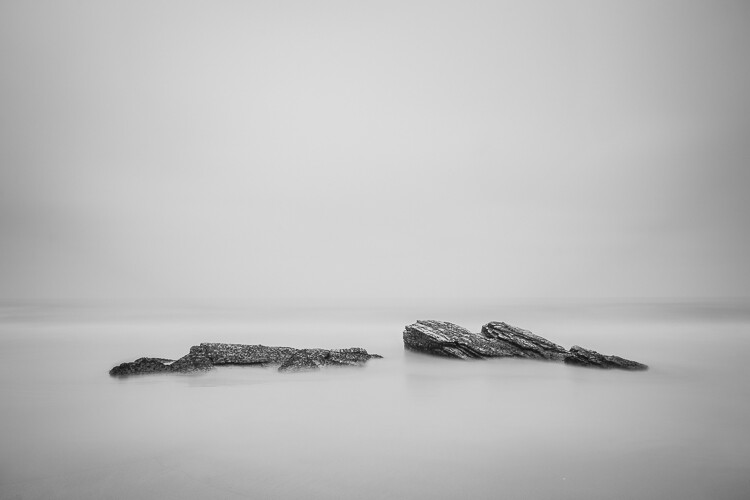
You’ll see this technique used a lot in long exposure photography, where you can take advantage of the juxtaposition between a subject with lots of texture, such as a concrete jetty, and one that has very little, like water blurred by using a neutral density filter and a long exposure. The earlier photo of two rocks is a good example.

Here’s another. I used a shutter speed of 3-minutes to blur the clouds and the water. As a result, there’s a strong contrast between the concrete in the foreground, the jetty in the distance, and the surrounding water and clouds.

How to Make Brilliant Black and White Photos with Dramatic Composition

#3 – Tonal Contrast

Tonal contrast is where you have light tones and dark tones next to each other. Now we’re getting to the heart of black and white photography! This technique is not nearly as effective in color because of the way that colors that are similar in tone, such as red and green, still create a powerful contrast. Tonal contrast is the main factor that separates black and white photography from color.

The easiest way to explain how tonal contrast works is with some examples.

In the first (below) there’s a strong tonal contrast between the white and black stones. Your eyes go to the white stones because they are in the center of the frame and because they provide a strong contrast against the black stones underneath them.

How to Make Brilliant Black and White Photos with Dramatic Composition

Another subject where tonal contrast is used to good effect is portraiture. In the portrait below the model’s light-toned skin contrasts with the dark background. The key to making this technique work is to make sure the background is in shade and that it contains no distracting highlights.

How to Make Brilliant Black and White Photos with Dramatic Composition

So far both examples have shown a light toned subject against a dark background. But you can turn it around by placing a dark subject against a white background.

That’s the technique I used in the following portrait. I photographed the man during carnival in Spain. He was dressed for the occasion and had even painted his face. I placed him against a bright, sunlit building to take advantage of the tonal contrast between his dark skin and the white wall.

How to Make Brilliant Black and White Photos with Dramatic Composition

Conclusion

There are many factors that make up a good black and white photo, but the composition is one of the most important. If you want to make a strong black and white photo, then focusing on these three key factors – simplicity, texture, and tonal contrast – is a great place to start.


Mastering Composition Book Two

Want to learn more about composition? Then check out my wildly popular ebook Mastering Composition Book Two. It contains 20 lessons that will help you get better at composition, no matter what your skill level!

The post How to Make Brilliant Black and White Photos with Dramatic Composition appeared first on Digital Photography School. It was authored by Andrew S. Gibson.

How to Show More with Your Photographs by Thinking Outside the Frame

The post How to Show More with Your Photographs by Thinking Outside the Frame appeared first on Digital Photography School. It was authored by Hannele Luhtasela-el Showk.

In its simplest form, a photograph is a representation of a very limited part of space at a very limited point in time. This article is about choosing which tiny bit of reality to represent and how that choice can make a photograph into much more than just a record of time.

01 photography tips thinking outside the frame

The most obvious elements of any photograph are the subject, the foreground, and the background. The light and the time it takes to create the photo are equally essential. In this article, I’ll be focusing on an ingredient which may be less obvious, sometimes even overlooked, but never absent: the frame.

What is the frame?

By frame, I don’t mean a picture frame, but the edges of the photo.

02 photography tips thinking outside the frame

Take a look at the photo above. What’s going on? There’s the subject (a cat) the foreground, a bench, the background (a pink wall) and a branch of some kind. So what does the frame have to do with all this?

The frame of a photograph is what separates the obvious from the inferred. It’s part of why a good photograph means different things to different people because that which is inferred is subjective.

Consider the photograph of the cat again. The cat is about to pounce, which means that there’s something going on outside the frame. Maybe another cat is walking by, or maybe there’s a delicious-looking bird on the ground.

What’s outside the frame is just as important

03 photography tips thinking outside the frame

What is left outside the frame can tell a story of its own or be an essential part of the subject of the photo? By creating tension between the obvious and the inferred you wield a powerful tool to make even better photographs. Every image has a relation to the rest of the world, even though the immediate surroundings aren’t obvious or don’t seem to add anything.

04 photography tips thinking outside the frame

So how do you start thinking outside the frame?

I will show you a few examples so you get the idea.

1 – Make it obvious

The obvious way is to make it clear that there is something outside the frame that isn’t being shown. The easiest way to do this is to capture an interesting gaze or photograph a detail.

05 photography tips thinking outside the frame

In the image above, the groom is not looking at the camera, but towards something more interesting outside the frame. For those who recognize the setting, it may be obvious that he is looking towards the church door, which will soon reveal the bride; for others, the interpretation could be different.

06 photography tips thinking outside the frame

These photos show a part of something larger. The hands suggest a person, and might even reveal something about that person. The spiraling tree creates a looping line that continues outside the frame.

2 – Tie the subject to the setting

The scene inside the frame can be tied to a larger setting without the subject directly or indirectly touching the frame. This can make the subject seem large or small, create an open or claustrophobic feeling, or give the surroundings a sense of continuity.

07 photography tips thinking outside the frame

Take a look at the photo above. By surrounding a tiny subject with a single, strong color, that color almost always feels like it continues on and on. In this picture, does it give you a sense of comfort or claustrophobia?

08 photography tips thinking outside the frame

The idea with the photo above is somewhat similar, but the feeling of it is quite different. Here is a playful animal in its seemingly limitless element, suggesting unlimited enjoyment. Or do you see something quite different?

3 – Use pattern or rhythm

By using a pattern or rhythm in the photo, you can create an effect that allows the viewer to imagine infinity. The idea is the same as in the example above, but the execution and effect are different. Here, the pattern or rhythm itself can be the subject, and it’s that subject that leads the viewer outside the frame.

09 photography tips thinking outside the frame

The pattern of cracked sea ice works like a block of color. But since it’s more interesting than just a single color, it can stand by itself and let the eye wander through the details in the photo and the mind continue beyond.

10 photography tips thinking outside the frame

A seascape like the one in the image above can suggest an infinitely large ocean just by showing an unbroken horizon. The ocean doesn’t only continue into the photo, though, it also continues sideways and beyond the edges of the photo. The rhythm of the clouds emphasizes this illusion.
4 – Reflections

Reflections are also an effective way of suggesting a wider world outside the constraints of the photograph. It’s a more direct way of pointing to the wider context.

11 photography tips thinking outside the frame

Concrete walls can suggest many things, but thanks to the reflection in the window it becomes quite clear that the photo is not taken in a concrete jungle, but in a verdant and sunny place. Reading the expression on the subject’s face becomes quite different thanks to the wider context.

Conclusion

Photography is always about choices, conscious or not. The more photography you do, the more deliberate your choices will become. Being aware of this gives you more control over your creative process. The creative decisions you can make based on those choices is what makes photography art.

How you frame your photographs is just one of the things to keep in mind when you photograph.

Do you pay attention to what you leave out when you take a photo? Do you have any examples or thoughts you’d like to share about how you’ve used the frame and what’s beyond as an element in your photography? I’d love to hear about it and see your photos in the comments below.

The post How to Show More with Your Photographs by Thinking Outside the Frame appeared first on Digital Photography School. It was authored by Hannele Luhtasela-el Showk.

How to Create a Center of Attention for Better Storytelling Images

The post How to Create a Center of Attention for Better Storytelling Images appeared first on Digital Photography School. It was authored by Kevin Landwer-Johan.

Drawing the viewer’s attention to the main subject in your photographs will help them understand your story more clearly. If you have a busy scene with no clear focus point it will possibly give your viewers an overall idea of what you were photographing, but they may not scrutinize it for long. Adding a clear center of attention will help you create better storytelling images.

How to Create a Center of Attention for Better Storytelling Images

Particularly when you are photographing a locality with a lot going on you can seek to isolate or draw the viewer’s eye to one main subject within your composition. By using this technique, you can develop a style which may become easily recognizable in your photographs.

Lessons from documentary photography

I first learned to make photographs like this while working as a newspaper photographer. My task was to illustrate and support the journalist’s story with my pictures. Making photos that compelled people to stop and look was always my priority. We wanted people to take notice, look at the photo, and read the story.

Photos of broad, general scenes will not achieve this so well as people will typically just flick past them.

How to Create a Center of Attention for Better Storytelling Images

Creating a photo essay to tell of your travel experience, an event you attended, a parade, etc., you will be aiming to convey what you saw and how you felt to best engage your audience. By creating a series of images where you have focused in on one main subject in each image you can build an overall illustration communicating to the viewer what it was like to be there. That is storytelling at its best.

How to Create a Center of Attention for Better Storytelling Images

Techniques

There are various techniques you can use to draw attention to one part of your composition. Using a shallow depth of field to isolate is one method. Using the contrast in light between your subject and the background, and various composition methods you can obtain pleasing results.

Play with the background

All of the photos I am using to illustrate this article are from a street parade in Chiang Mai, Thailand. With a lot of people, often cluttered backgrounds, and no real control or means of setting up photos, it’s a challenging situation in which to shoot.

How to Create a Center of Attention for Better Storytelling Images

Finding a dark background to help isolate your subject is not always so easy, but when you can it will produce some great photos. In this photo of the boy playing a large drum, I positioned myself so the background was totally in shadow and therefore underexposed.

This has achieved isolation of my main subject and you easily focus your attention on him. My timing to capture a smile and interesting positioning of his drumstick also helped. On its own though, this photograph does not do much to illustrate the parade and environment.

How to Create a Center of Attention for Better Storytelling Images

Coming in close to the French horn player (with a 35mm lens on a full frame camera and a wide aperture) I was able to isolate him and at the same time convey more information about his activity and location. Making him the center of attention and at the same time leaving him in context helps tell the story.

Had I used a longer lens it would have included less background and it may have been even more blurred, further distorting the detail and therefore the context of the story would be lost.

Using compositional elements

How to Create a Center of Attention for Better Storytelling Images

Using different composition methods such as framing or converging lines you can help draw your viewer’s attention to your chosen subject.

Often during our workshops, I find people want to include too much in their photos. I encourage them to include less and take more photos build up a story that way.

While it is good practice to create a photo essay which has a varied selection of wide, medium and close-up photos, trying to capture too much of what’s in front of you can often produce rather uninteresting photographs. Bringing one part of your composition to the foreground as the center of attention is a more effective means of holding a viewer’s focus.

How to Create a Center of Attention for Better Storytelling Images

Single or multiple photos

At the newspaper most often each story was accompanied by a single photograph. So the challenge was to produce one image supporting the narrative of the story. Not always so easy, especially with an event like a parade.

I often encourage people to photograph as if they are shooting to cover a story for a magazine. The aim being to come away with a series of photographs that together will tell the story of their experience. To finish up with 6-10 photos having a clear center of interest in each one and conveying the overall experience of the day.

How to Create a Center of Attention for Better Storytelling Images

If you produce a small collection of photos most social media and photo sharing sites have means to display them together in an album or gallery so it’s a great way for you to share your stories and your experiences.

Your turn

You can see some of these tips in action in the video below. Please share your tips and thoughs on creating more storytelling images by having a center of attention in the comments below.

The post How to Create a Center of Attention for Better Storytelling Images appeared first on Digital Photography School. It was authored by Kevin Landwer-Johan.

A Fresh Look at Learning Photographic Composition

The post A Fresh Look at Learning Photographic Composition appeared first on Digital Photography School. It was authored by Kevin Landwer-Johan.

Popular teaching about photographic composition says to learn the rules and then break them. I prefer to encourage the people who join our photography workshops to learn the rules, understand them well and put them into practice so frequently they become second nature.

If you can apply the rules without even consciously thinking about them you will create more dynamic, interesting photographs which convey more feeling.

A Fresh Look at Learning Photographic Composition

Why do we have rules?

Rules are important as they are the underlying structure of composition. Much like scales are to musicians. Much like grammar is to language.

Successful musicians have typically spent long hours going over and over the same scales until they know them so well they do not need to think about them. When we learned our first language, our “mother tongue”, we never consulted the textbooks to study the grammatical structure of the language, we just absorbed it, (most frequently from our mothers.)

A Fresh Look at Learning Photographic Composition

Some people will have more difficulty learning the rules of composition and applying them effectively than others. Very much like some people can learn to play musical instruments or learn new languages easier.

I think it is because we are all creatively gifted in different ways. If you are gifted with a visual creativity you may find it easier to compose photographs than say someone who is gifted with a musical creativity and finds it easy to play the guitar or trumpet for example.

A Fresh Look at Learning Photographic Composition

I do like what the famous American photographer Edward Weston had to say about learning and implementing the rules of composition:

“Now to consult the rules of composition before making a picture is a little like consulting the law of gravity before going for a walk.”

I doubt any of us can recall studying the law of gravity before we learned to walk. But we certainly knew about it.

A Fresh Look at Learning Photographic Composition

Know them at a subconscious level

Knowing the rules is important as they will help guide our creative thinking, but applying these rules rigidly will generally lead towards making rather static and lifeless photographs. As you learn the rules and know them so well you can incorporate them into your photographs intuitively you will find your images may take on a whole new dynamic. Very much like walking and talking, it’s good to be subconsciously aware of the rules and laws as they are there for good reason.

A Fresh Look at Learning Photographic Composition

Practice constantly

Reading about and studying the rules of composition will help you gain a good understanding of them. Practicing them frequently is the most effective means of consistently integrating them into your photographs. Practice them even when you don’t have your camera with you.

Begin to see in the rule of thirds, discover leading lines and strong diagonals, look for frames and how you can use symmetry. One side effect of seeing like this will likely be that you start taking your camera everywhere with you.

Fill the frame

When I first started working in the photography department of a newspaper it was impressed upon me to “fill the frame”. This encouragement has stuck with me and I am aware, consciously or subconsciously, of wanting to effectively achieve this with every photograph I make. This was important in the newspaper in order to convey the story effectively, (and so sub-editors had less flexibility to horribly crop your photos).

A Fresh Look at Learning Photographic Composition

Filling your frame does not mean that in every photo your subject must be pressed out to the edges of your viewfinder. It means however you are choosing to compose your photograph, make sure whatever is within the four corners and edges is relevant to the picture you are making.

A Fresh Look at Learning Photographic Composition

If empty space is relevant and adds to your composition, use it well. If cropping in so tight that part of your subject is cut off makes a stronger image, then crop tight.

However you decide to compose your image, be happy with it. Don’t get hung up on the rules. But do have a solid understanding of them and explore how you like to incorporate them into the creative photographs you are making. And, if you so come up with any new rules, please do let me know!

Here’s a little video talking about this concept of composition.

The post A Fresh Look at Learning Photographic Composition appeared first on Digital Photography School. It was authored by Kevin Landwer-Johan.

Video Tips: Composition Dos and Don’ts For Creating Better Images

The post Video Tips: Composition Dos and Don’ts For Creating Better Images appeared first on Digital Photography School. It was authored by Darlene Hildebrandt.

How you compose or arrange your frame is one of the keys to creating interesting and compelling images. So learning some composition rules, and when to break them is essential.

Here are three short videos to help you see what to do and what to avoid in your composition.

Composition Mistakes to Avoid

Learn what not to do in this video including:

  • Double subjects
  • Looking out of the frame
  • Tangents (lines cutting through the subject)
  • Lazy composition

Beginner’s guide to composition

In this second video, Jordan from Sleeklens gives you four tips you can use to help elevate your photography composition.

The four tips covered include:

  1. Rule of thirds
  2. Balance
  3. Symmetry
  4. Leading Lines

9 Composition Tips

Finally, in this last video from COOPH you will see nine more composition tips based on the images of master photographer, Steve McCurry.

Do you have any other composition tips you would like to share? Please do so in the comments section below.

The post Video Tips: Composition Dos and Don’ts For Creating Better Images appeared first on Digital Photography School. It was authored by Darlene Hildebrandt.

How to Use the Background to Create More Storytelling Images

The post How to Use the Background to Create More Storytelling Images appeared first on Digital Photography School. It was authored by Mat Coker.

Sometimes you’re so focused on capturing the moment that you forget to pay attention to what’s in the background of your photo. When you look at your photos later, you realize that there are all sorts of distractions in the background. One way to overcome these distractions is to use the background to help with storytelling in your photo.

Even though “the moment” is likely the most important part of your photo, good moments always happen in a place. Use the background to show where your moment or story takes place.

Think of People as Characters

The first thing I recommend is thinking of the people in your photo as characters. When you’re going to take a picture of somebody ask, “Who is this character and what are they doing?” When you answer these questions you’ll be able to choose a good background to help tell that story.

Storytelling background 15

This is a photo of my son. I wasn’t thinking of him merely as my son, but rather as a “hiker.” Thinking of him as a hiker helped me choose a background that portrayed the story of a hiker.

Two Ways to Choose a Background

There are two ways to choose a background for your photo.

  1. You can begin with your character and then choose the right background for them.
  2. Or, you can begin with a good background and then look for a character to put into the scene.

Finding a Background that Matches Your Character

Keep in mind the two questions to ask yourself; “Who is this character and what are they doing?”

In this photo, the character is my infant son and he is sleeping in a carrier on my wife’s back. It’s a cute picture, but there is no way to tell from the background where we were when this took place.

Storytelling background 01

This is a nice photo, but the background doesn’t add to the story.

We were on a camping trip and I knew I wanted a collection of photos that would show that. So I repositioned myself to find a better perspective and show the camp trailer in the background. This added a sense of place to the photo.

Storytelling background 02

The camp trailer in the background adds context to the photo of the sleeping infant.

Later on that summer it came time to chop wood for the winter. My little guy wanted to help daddy!

Naturally, I wanted a photo of him trying to chop wood. Depending on the perspective I chose there could have been trees, water, or a wood pile in the background. Since this is a photo about chopping wood, I chose to have the woodpile in the background.

There is even some wood in the foreground, reminding me of what a big job we had that summer!

Storytelling background 03

The huge pile of wood is a natural background for the little wood chopper. Plus it emphasizes how small he is comparatively.

Next time you’re about to snap a photo of somebody, stop and consider your background. Can you move around in order to get a good background to help with storytelling?

Finding a Character to Fit the Background

There may be times when you want to photograph an interesting scene but feel that there is something missing. Perhaps it is the character that is missing. When you come across an interesting scene, go ahead and photograph it. But also wait and allow that scene to become a background for some interesting characters.

When we visited Halls Harbour in Nova Scotia, the rugged shoreline was an obvious feature to photograph. I experimented with different angles and perspectives, but I knew I needed some good characters in the scene. Finally, a couple with their dog came walking down the shoreline. When the man began skipping stones out into the water I knew that these were the characters I was awaiting.

Storytelling background 04

These people and their dog were the perfect additions to the rugged shoreline.

Instead of just a photo of a beautiful landscape, this has become a story about a family on an adventure. To me, skipping stones into the water is a nostalgic sort of moment, so I decided this story looked best in black and white.

Make a story

When the tide was low we could walk out into the harbor amongst the ships that were now resting on the ground. Again, this was an interesting scene that just seemed to be missing a character. Then my son came tip-toeing through the mud and became the perfect character to fit the scene.

Storytelling background 05

When I let my imagination carry me away, I pretend that my son has pulled the plug in the harbor and all the water has drained out. He better sneak away before he gets caught!

Using framing

On a trip to Niagara Falls, we ducked into a building to get some relief from the cold wind and mist from the falls. Through the windows, we could see the falls and a rainbow that was produced through the mist. I wanted to take a photo but waited until my kids went and stood in the window. This allows the falls and rainbow to make up the background while my kids are the characters in the scene.

Storytelling background 06

The characters in the foreground allow the viewer’s attention to be drawn to the falls and rainbow in the background.

Plan ahead

In these next two examples, I used our house as a background for the photo. We were getting ready to move in the spring and I knew we needed a few more photos, by which to remember this old house. So I was determined to use our house as a setting and photograph more scenes with it in the background.

That winter, we built a snow hill nearly as tall as the house itself. That was a perfect opportunity to photograph an exciting event with our home in the background.

Storytelling background 07

A low angle helped to capture this epic moment right in our front yard. The snow hill towers in front of the house in the background.

Storytelling background 08

Our kids will always remember their first childhood home (and the fun they had there) when they look back on these photos.

Next time you come across a nice scene, go ahead and photograph the scene by itself. Once you have done this, you can look for a character to add to the scene, allowing it to become a background for their story. This is a perfect approach for both landscape and street photography. Choose the background and then wait for the character to come along.

Symbolic Backgrounds

So far, all of the backgrounds in these photos have been literal scenes. But you can use a background to give your story some symbolic meaning as well. You do this by finding a background that makes you think deeper than the literal object itself. For example, a sunset in the background isn’t just about the sun, perhaps it’s about “romance” or “a happy ending.”

In this example, my wife is tying up vines in a vineyard. This is a job that needs to be done in the spring before any green actually appears on the vines. There really wasn’t anything nice near her to use as a background, except golden light from the setting sun.

To me, vineyards are about long days of outdoor work, and the romance of shared wine. The warm setting sun was the perfect symbolic background to express these feelings.

Storytelling background 09

The golden sun in the background of this photo is symbolic of the day’s end, and the romance of wine and vineyards.

When you’re photographing a character doing something interesting, ask yourself if there is anything in the background that adds symbolic meaning to what they’re doing.

I have lots of photos of my kids reading books. The following photo is an example of a very boring background that does not help to tell a story.

Storytelling background 10

This background is distracting. The bed leg is growing out of their shoulders and pulls our attention away from what the kids are doing.

You can come up with some great backgrounds for people reading books. A library or a coffee shop would be two good choices for your background. But these are obvious choices and perhaps you could choose a symbolic background instead. Think about the nature of reading and how a person grows as they learn.

Storytelling background 11

This is exactly the sort of place that many people would sit and read a book. There is something about old leather chairs that invite you to nestle in and read. Behind the chair is a wood grain wall. Wood is something that grows. Wood is symbolic of the “growth” that happens when a child learns and reads.

Keep your eye open for backgrounds that are symbolic of the story you want to tell.

Using the Background to Tell a Story in Multiple Photos

When you find a good background, go ahead and use it in different ways to expand on your story.

The following photos are all from Hopewell Rocks in New Brunswick. Every tourist who has ever been there, walks away with the same photos from the same perspectives, so I challenged myself to come away with something different. I wanted photos of the rocks, so I used them as the background for the scene and then waited for interesting characters to come along.

The first thing I noticed was lots of tourists rushing around snapping pictures of the rocks. They were always getting in the way of the photo I was taking, so I gave up and took pictures of them instead.

Storytelling background 12

I like how this tourist blends into the rocks. As they reached out their arms to take a photo, their arms mimicked the circle shapes in the rocks.

Two-year-olds are notoriously difficult to photograph. I wanted to take a photo of my daughter with the rocks in the background. But all she wanted to do was chew on saltwater stones. She had been doing this on our entire trip. We were constantly telling her to get the rocks out of her mouth.

Storytelling background 13

If you’re going to photograph a two-year-old, you might just as well photograph her doing what she loves. And what better background for her photo than the massive rocks?

The tide was rising quickly and would soon cover the massive rock formations. In our last moments there something spectacular happened. A park ranger made his own rock formation by balancing several odd shaped rocks on each other.

Storytelling background 14

What a contrast between the massive Hopewell Rocks and the man-made formation. The force of the tide eroded one set of rocks over a long period of time and will quickly topple the rocks that have been so carefully balanced by the ranger.

When you stick with a scene long enough wonderful things happen and your mind will find symbolic meaning that you otherwise might have missed.

You’ll Enjoy Your Photos More When Your Background Adds to the Story

Don’t let your backgrounds be a disappointing afterthought. Instead, consider how the background in your photo can add storytelling elements to your character.

Remember the steps:

  • When you’re going to take a picture of somebody, first ask yourself, “Who is this character and what are they doing?” When you answer these questions you’ll be able to choose a good background for storytelling.
  • You can choose a background for your character, or find a good background and wait for the perfect character to come along.
  • Try using backgrounds to give symbolic meaning to your photos.
  • Use the background in different ways over several photos.

When you pay attention to the background your photos will become less sloppy and more meaningful. Please share some of your images with storytelling backgrounds in the comments below.

The post How to Use the Background to Create More Storytelling Images appeared first on Digital Photography School. It was authored by Mat Coker.